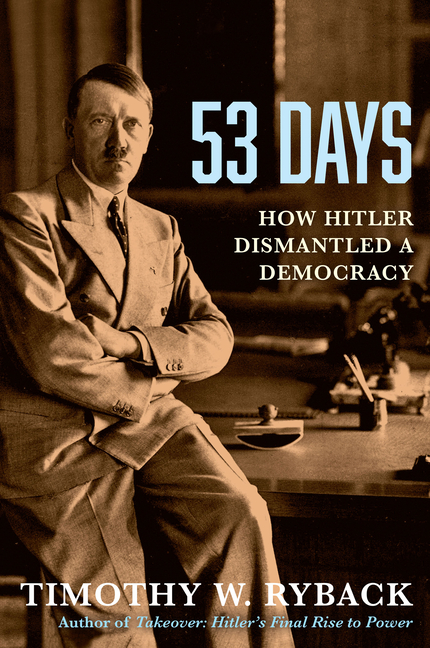
53 Days: How Hitler Dismantled a Democracy
To a remarkable degree, Ryback’s brisk narrative titrates the exact proportion of detail and context to enliven these moments and never dawdles over any single standoff; the book, which is a short 244 pages, really moves ... These occasional tics are less distracting, however, than Ryback’s frequent, at times gratuitous, winks at the Trumpian present. To be clear, Ryback rarely if ever compares Donald Trump and Adolf Hitler explicitly. Instead, he summons and summarizes details from the Nazi past that unmistakably rhyme with the present, leaving it to his discerning readers to make the connection ... But as I read 53 Days, the relentless fire hose of almost too-perfect analogies raised my suspicion: Are these details the most historically salient? Or were they only chosen for their resonance with the present? Worst of all, Ryback’s coyness — paired with the barreling pace of his narrative — deprives his readers of the equally valuable flip side of historical analogy: that is, disanalogy, the opportunity to contrast our two epochs and glean something from the differences.
Step by step, the book recounts the process by which Hitler exploited his position in order to install autocracy. Ryback deftly manages what could have been an unwieldy narrative, allowing readers to draw their own conclusions about the book’s relevance to current events.
Read Full Review >>
For all Hitler’s malignant energy, however, Ryback styles the fascist takeover as democracy’s own 'suicide': pushback from courts and state governments was weak, business leaders caved to Nazi demands for funding, the Weimar constitution was fatally flawed in allowing emergency decrees, and Hindenburg’s indulgence of Hitler’s authoritarianism likely stemmed from his own yearning for a return to monarchy. It’s a trenchant depiction of democracy as most vulnerable when its stewards are insufficiently committed.
Read Full Review >>