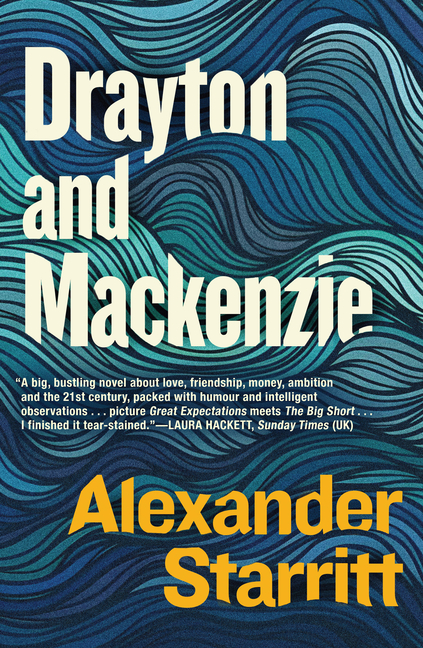
Drayton and MacKenzie
Starritt’s book treats business with seriousness and respect. This is not a satire for an age that is side-eyeing capitalism ... The book’s second half can be slightly bloated ... But the plot remains mostly aerodynamic and the relationship between James and Roland is richly developed ... Starritt’s book is not just for business readers who might feel too often ignored in the pages of literary fiction; it has all the pleasures of a traditional, decades-spanning tale about individuals both caught up in and influencing history. One might ponder, while reading it, some fruitful questions about the very nature of socially attuned novels, but only while Starritt does his job and then some.
Read Full Review >>
It’s a mark of Starritt’s confidence that the quest to harness tidal power – the book’s main business – gets going only 200 pages in. We feel in safe hands from the start, reassured that he knows the story’s every last turn ... With a joyful knack for pithy analogy, the writing holds our attention as much as the events ... while there’s no shortage of chat about electrolysers and optimal blade rotation, Starritt keeps his focus on the human story of invention: dangling quietly over the action is the fact that James, lauded as a visionary, relies mostly for his ideas on other people. In the end, though, critique of disruptor-era genius is less important here than feeling and friendship.
Read Full Review >>
This is a big, bustling novel about love, friendship, money, ambition and the 21st century, packed with humour and intelligent observations ... Starritt is particularly good at capturing the millennial generation and its gripes ... Starritt’s depiction of the credit crunch elevates the novel to something more than a corporate Sally Rooney novel for boys ... This is an eyes-glinting, teeth-bared satire — of Oxbridge, of management consultancy, of tech bros and start-ups, of the British class system — but Starritt’s heartbreaking conclusion cuts through all that sarcasm and cleverness. I finished it tear-stained, feeling a bit hollowed out.