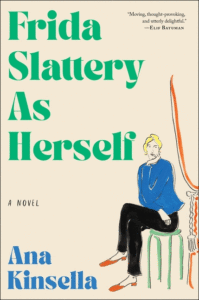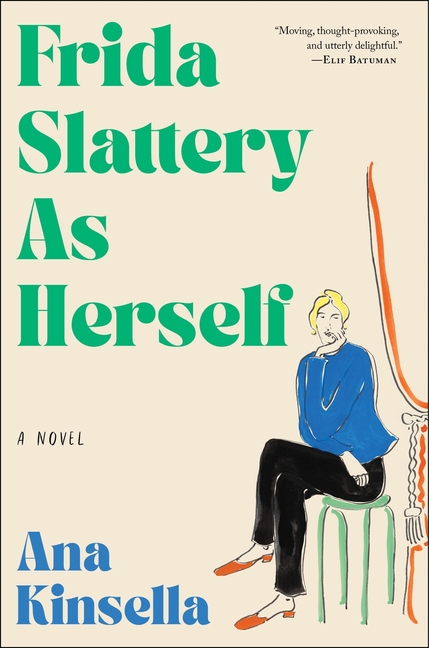
Frida Slattery as Herself
The prose does not always match the sophistication of its ideas. Kinsella has a tendency to fall back on familiar phrasing at precisely the moments that demand greater acuity ... Still, what sustains Frida Slattery As Herself for 500 pages is its commitment to emotional complexity. Kinsella is interested not only in the drama of the relationship but in its subtler recalibrations — the way it evolves, fractures, reforms — as well as the way artistic collaboration can illuminate and obscure emotional truth. Beneath the love story runs a thoughtful thread about the stories women tell themselves regarding instinct, ambition and compromise, and the extent to which those instincts are continually second-guessed ... This lays the groundwork for a very moving conclusion about creative and romantic risk, and about two people, well into their forties, still trying to work out what they are allowed to want.
In a way the engine of the book is romantic – will they end up together? – but while this keeps the plot ticking over, the magic of their connection comes, pleasingly, in their creative collaboration. Frida in particular is a delightful character because her spontaneity and self-doubt make her feel so authentically real; John, a thinker, is perhaps slightly less interesting. Nonetheless, the most enjoyable parts of the book are when they are together, writing, improvising, rehearsing, experimenting ... Inside the reliable pull of a well-written love story, Frida Slattery As Herself is a skilful, unusual novel – clever, ludic and unexpected in the way of good theatre.
Read Full Review >>
The book was acquired by Scribner in a six-publisher auction, and it’s easy to see why editors might have been excited ... Kinsella is pleasingly attentive to story, detonating little plot points at frequent intervals, ensnaring her reader in the characters’ emotional turmoil. The characters themselves are absorbing and believable – even the peripheral ones like Kitty and Edel. Her writing style is easy and understated, with regular illuminating lines ... It’s also, as debut novels should be, a big, earnest exploration of existential questions such as selfhood, womanhood, family, freedom, and what it is to be an artist. My one reservation concerns the ending, which is somewhat withheld, a deliberate stylistic choice, but one that left me feeling a little cheated. Endings aside, this is an effortless, elegant and impressive debut from a promising young writer.
Read Full Review >>