The Once and Future Riot
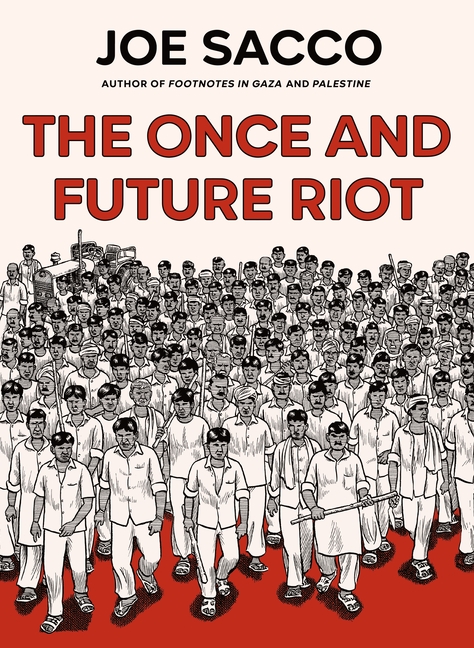
There’s wit and realism in the panels and art. It’s dynamic and clear, and the people seem less like caricatures than in Palestine ... The skin tone of all of the protagonists is dark, and the shading is done not by cross-hatching, but by parallel horizontal lines. Once I noticed it, it became distracting, like TV interference on every character’s face, and I couldn’t unsee it. This may seem like a pathetically trivial point, but comics are a visual medium ... In an era when long-form journalism is under pressure, and political analysis filleted to morsels, Sacco’s work is a lifeline.
Read Full Review >>
Through his stark black-and-white images, Sacco captures the dying days of what future historians might come to regard as India’s 'First Republic' ... Sacco is well known for his attention to detail, a trait amply on display in this book. At one level, sharply observed drawings convey how hundreds of finely delineated individuals coalesce into the terrifying collectivity that is the crowd. At another level, precisely etched close-ups capture the range of emotions – from anxiety to anger – of his interviewees.
Read Full Review >>
The Once and Future Riot concerns a series of escalating clashes in the northern Indian state of Uttar Pradesh ... It is now widely agreed that 62 people were killed, two-thirds of them Muslim, and 50,000 people, again mostly Muslim, were driven from their villages. But when Sacco arrived, more than a year later, details about who was responsible for the violence and who was harmed proved strikingly hard to pin down. He encountered something more potent than facts: 'the fiction, the myth,' as he puts it, a set of competing (and politically convenient) narratives that are already taking the place of the historical event ... Based on witnesses’ recollections, he draws massive crowd scenes in which hundreds or even thousands of people converge and clash. To keep the reader from losing their way, he tiles these full-page panels with smaller inserts, revealing visually who is providing what testimony. But these stories quickly begin to contradict one another—and Sacco’s presentation of his interviewees’ faces and names takes on a second layer of meaning, showing how a journalistic reconstruction is pieced together from disparate sources, sometimes overlapping and sometimes conflicting, which illustrates handily that the story he is constructing is not the only one on offer ... Sacco is searching for a story, and he eventually finds it, sometimes at the cost of the subject’s human dimensions ... This might be an unavoidable shortcoming, but it can undermine what is best in his method, as well as the higher ideas he’s using the book to pursue. Victims emerge and disappear, without much time given over to individuating them. He does not probe their life stories, as he did with Omm Nafez and Khamis back in Gaza; he must race off to the next source. Like figures in a massive spread, they lose their particularity, and they form again as a collective, a swirling mass where no face can stand out. Then again, what the cartoonist loses in detail he gains in scope. The Once and Future Riot is a new sort of book for Sacco, more philosophical than humanistic, its eye trained on larger social and political structures ... After a career spent reporting on ethnic chauvinism, criminal impunity, and history’s endlessly reopened wounds, he has stepped back to take in the long view. The outlook isn’t bright.
Read Full Review >>