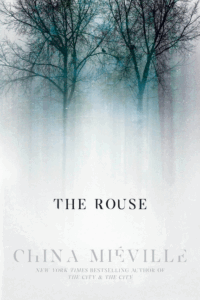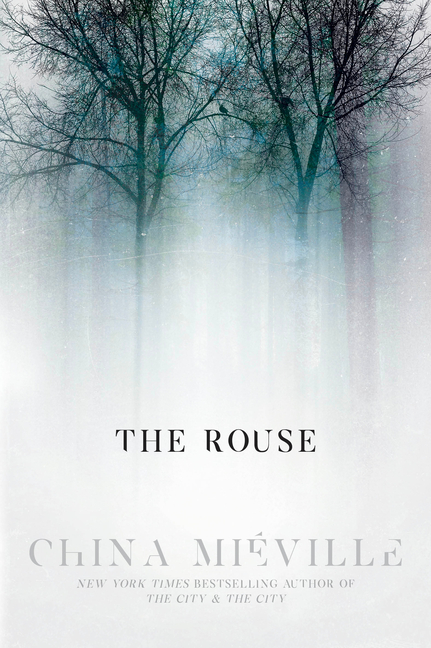
The Rouse
If The Rouse sometimes reads like John le Carré’s A Perfect Spy by way of J.G. Ballard and Max Lury, Miéville transcends those comparisons with unparalleled lunges of thought about the spirit world that leave one breathless with their audacity. Literature itself becomes weaponized, part of the summoning of the dead ... There is an emotional cadence, and even a rough joy, that enlivens what one might label exposition or theory — a searing incandescence illuminating the weightier material, like a pulsing line of red on metal being worked in a foundry ... The academic language in the novel becomes urgent. Miéville is able to flex certain muscles — perilous for most fiction writers — in ways that support the dramatic tension rather than drain it ... I’ve rarely read scenes so terrifying, achieved with a kind of stutter-step language, words that intensify and recede with such incantatory power. These passages seem unparalleled in literature and somehow bypass the brain to jolt the nervous system directly. Over its 1,200 pages, the novel becomes a haunting of a haunting, a terror echoed and heightened over time. This terror grows familiar but not stale; the reader is allowed to live within it almost calmly and thus catch glimpses of other forces in the darkness. What Miéville has crafted in The Rouse is an intimate epic, a controlled sprawl of history and emotional resonance. I felt it in my bones, the undeniable power of a jagged masterpiece.
Read Full Review >>
The Rouse is a quantum jump in terms of ambition, moral seriousness and stylistic bravado. It means that rather than classifying Miéville with 'the new weird' or 'speculative fantasy', he ought to be compared to Roberto Bolaño or Mircea Cărtărescu. This new novel is equally maximalist, dense, disorienting and discomfiting, reflecting how surreal our reality seems to have become ... In a sly aside, there is praise for John le Carré, whose version of the world of spooks is less paranormal than Miéville’s. Their books share the shabbiness of cold war espionage, and an ambience of regret for the days of simple us v them situations, but also the capacity to keep the reader guessing about the true affiliation and trustworthiness of the characters ... This is a novel destined for a rich afterlife.
Read Full Review >>
Miéville could have published this [first 190 pages] as a standalone novel to plaudits and credit. Instead, he continues ... The novel continues, by turns an adventure–thriller, a spy story, a quest tale. But the ghost story persists, expands, swallows the narrative. The Rouse grows vaster than empires and more slow, a creep that drags the narrative momentum ... There are many encounters with uncanny presences, creatures, things lurking in the shadows, but repetition wears the barbs of this kind of writing smooth. It’s not badly done, but its scary-spookiness suffers from diminishing returns ... There’s an awful lot in this enormous novel, but I’m not convinced ‘the ghost story’ is really able to encompass the whole of history from 1950 to the present day, the myriad lives that intersect. The Rouse includes striking scenes, vivid and sometimes disgusting writing, but it is not just long, it is too long. Rather than aggregating the weird, the novel’s extensiveness dilutes it. The reader has supped overfull of horrors long before they turn the final page.
Read Full Review >>